


Super El Niño 2026–27: How to Prep Your San Francisco or Marin Yard Before the Big Storms
The ocean is sending a clear signal. On October 8, 2026, NOAA’s Climate Prediction Center reported that El Niño is still strengthening, with a strong-to-very-strong event likely through early 2027 and high odds of a historic one (NOAA CPC). For San Francisco and Marin homeowners, that makes this fall the time for El Niño yard prep — before the ground is saturated and every landscaper in the county is booked.
Here’s what a super El Niño could mean for your property, a practical prep checklist, and the bigger fixes worth doing while the weather still cooperates.
What a Super El Niño Could Mean for Bay Area Yards
El Niño raises the odds of a wet, stormy California winter, but it’s not a guarantee — especially this far north. The Bay Area sits near the northern edge of El Niño’s typical wet zone, and the strong 2015–16 event actually delivered a drier-than-average Bay Area winter (Bay Nature).
When a big one does deliver, though, it delivers. During the 1997–98 El Niño, San Francisco recorded 47.22 inches of rain — about 230% of normal — including 14.89 inches in February 1998 alone (Golden Gate Weather Services). That same winter, about 300 damaging landslides hit the 10-county Bay Area, with more than $150 million in direct damage (USGS).
Two risks are close to certain no matter how much rain falls:
- Higher tides. El Niño temporarily lifts sea level by roughly 6–12 inches, so this winter’s king tides are likely to run higher than usual (Bay Nature). Low-lying parts of San Rafael, Sausalito, Pacifica and San Francisco already flood at king tide (KQED).
- More intense storms. Forecasters expect atmospheric rivers to skew stronger, even if the number of storms doesn’t change (KQED). Intensity is what overwhelms gutters, drains and slopes.
The smart move: prepare as if it will be a 1997–98 winter. If it isn’t, you’ve still fixed problems that every normal winter exposes.
Your El Niño Yard Prep Checklist (Before December)
1. Watch where the water goes in the next rain
Put on a raincoat during the next real storm and walk the property. Note where water pools, where it sheets across paths, where it enters the crawlspace or garage, and where it leaves the lot. Take photos. That 20-minute walk tells you more than any forecast. Our winter drainage checklist walks through what each pattern means.
2. Clear gutters, downspouts and drain inlets
Fall leaf drop plus the first storm is a recipe for overflowing gutters. Clean gutters after most leaves are down, flush downspouts with a hose, and clear grates on area drains, driveway trench drains and the storm drain at your curb.
3. Move water away from the foundation
Soil next to the house should slope away from it — at least 2% is the Bay Area stormwater standard (BASMAA rain garden guide). Add downspout extensions or connect downspouts to a solid pipe that discharges to a safe spot. A downspout that dumps at the foundation is one of the most common causes of a wet crawlspace.

4. Turn down the irrigation
An irrigation system running between storms is wasted water and extra saturation. Set controllers to rain-skip or seasonal-off, and confirm smart controllers are actually reading local weather. We cover this in Smart Irrigation Management.
5. Cover bare soil
Bare soil erodes, compacts and turns to mud. Spread 2–3 inches of arborist chip or shredded bark mulch over planting beds, keeping it a few inches back from plant stems. On slopes, add straw wattles across the grade before the first big storm.
6. Get your trees checked
Saturated soil plus wind is when trees fail. Look for dead limbs over the house, driveway or play areas, and for trees leaning more than they used to. For large trees, get an ISA Certified Arborist to assess them now, not after a branch is on the roof.
7. Line up sandbags early
When a big storm is forecast, sandbag sites run out. Get them now.
- San Francisco: Public Works gives residents up to 10 free sandbags at its operations yard (Marin Street/Kansas Street gate), Monday–Saturday, 8 a.m.–2 p.m., with proof of address (SF Public Works). Confirm hours before you go.
- Marin: The County lists about 34 free sandbag sites, including fire stations and town corporation yards, on an interactive map. Bring a shovel; some sites limit bags per household (Marin County OEM).
8. Sign up for alerts and check your flood coverage
Marin residents should sign up for Alert Marin and review ReadyMarin’s flood guidance. Standard homeowner’s insurance does not cover flooding, and a new NFIP flood policy has a 30-day waiting period before it takes effect (FEMA) — so the time to decide is now, not when the storm is on the radar.
Bigger Fixes That Pay Off in a Wet Winter
The checklist handles routine maintenance. If your walk in the rain showed water heading toward the house, standing for days, or carrying soil off a slope, the property needs a real drainage solution. Fall is the window to build it: soil is workable, and crews can grade and trench before the ground saturates.
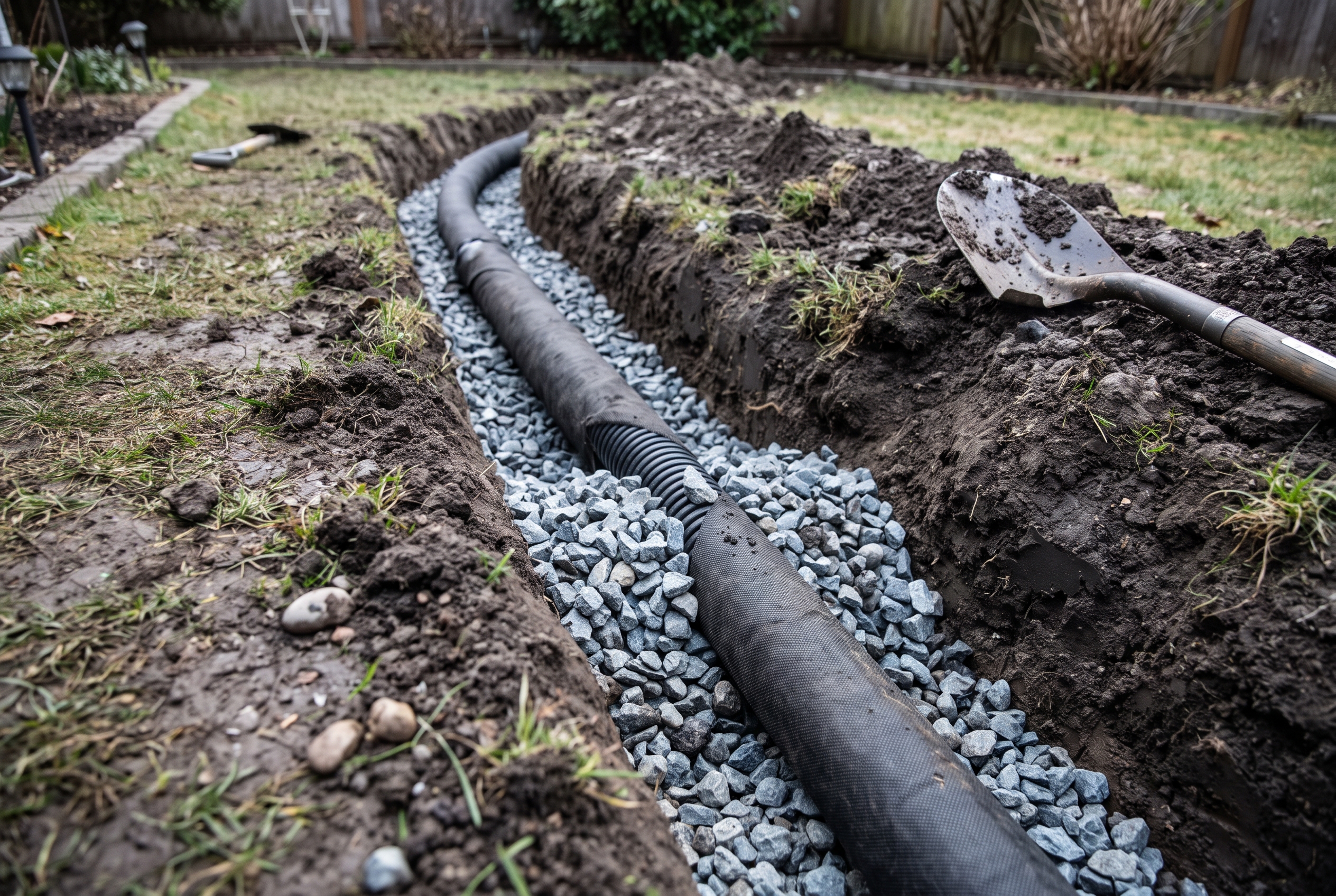
- Regrading. Reshaping the ground so water moves away from structures and toward a safe outlet. Often the single most effective fix.
- French drains and dry wells. Gravel-and-pipe trenches that intercept subsurface water and move it to a dry well, rain garden or approved outlet.
- Permeable paving. Replacing solid concrete patios and paths with permeable pavers or set stone lets rain soak in instead of running toward the house. See Hardscape Construction.
- Rain gardens. A shallow planted basin that holds roof runoff and lets it soak in. Bay Area guidance puts them at least 10 feet from foundations and sizes them at roughly 4% of the roof or paving that drains to them (BASMAA).
- Retaining walls with drainage. A wall without drain rock and a perforated pipe behind it is a dam. Ours are built to let water out.

San Francisco homeowners: the SFPUC Floodwater Management Grant reimburses eligible flood-protection work for properties that flood from the street or from sewer backups, including flood barriers, backflow preventers, sump pumps and driveway regrading — up to $100,000 per its most recent announced terms (SFPUC). Check eligibility before you design the project.
All FYGN drainage work follows local codes, and we’re a licensed C-27 landscape contractor (License #859766). See our installation services for the full scope.
What Not to Do This Winter
- Don’t dig or till wet soil. Working saturated clay destroys its structure and leaves it compacted for years. Wait a few dry days.
- Don’t fertilize before a storm. Rain washes it into storm drains and the Bay.
- Don’t plant into waterlogged ground. Plant between storms, not during them.
- Don’t push leaves or soil into the street or a creek. Storm drains flow untreated to the Bay, and clogged inlets flood your street first.
El Niño Yard Prep FAQ
Will El Niño make this Bay Area winter wetter?
It raises the odds but doesn’t guarantee it. The Bay Area is at the northern edge of El Niño’s typical wet zone. The very strong 1997–98 event roughly doubled San Francisco’s rainfall; the strong 2015–16 event did not.
When should I prepare my yard for El Niño?
October through early December, before soils saturate. Drainage construction is far easier and cheaper in dry soil.
Does FYGN install drainage in Marin and San Francisco?
Yes. We design and build regrading, French drains, dry wells, rain gardens, permeable hardscape and retaining walls throughout San Francisco and Marin County.
Get Your Yard El Niño-Ready
Want a second set of eyes before the storms arrive? FYGN has served San Francisco and Marin since 2001. We’ll walk your property, show you where water is going, and give you a clear plan — from a one-day cleanup to a full drainage rebuild.
Call (415) 595-0227 or contact us to book a storm-prep site visit.
Discover more from FYGN | For Your Gardens' Needs
Subscribe to get the latest posts sent to your email.